
![[IZ MEDIJA] JOŠ TRAJE FESTIVAL SOLI NA PELJEŠCU](https://ston-dvor.com/wp-content/uploads/2023/07/naslovna_6.jpeg)
All pools in Ston Saltworks are named after saints, except for one – there's a good reason for that!
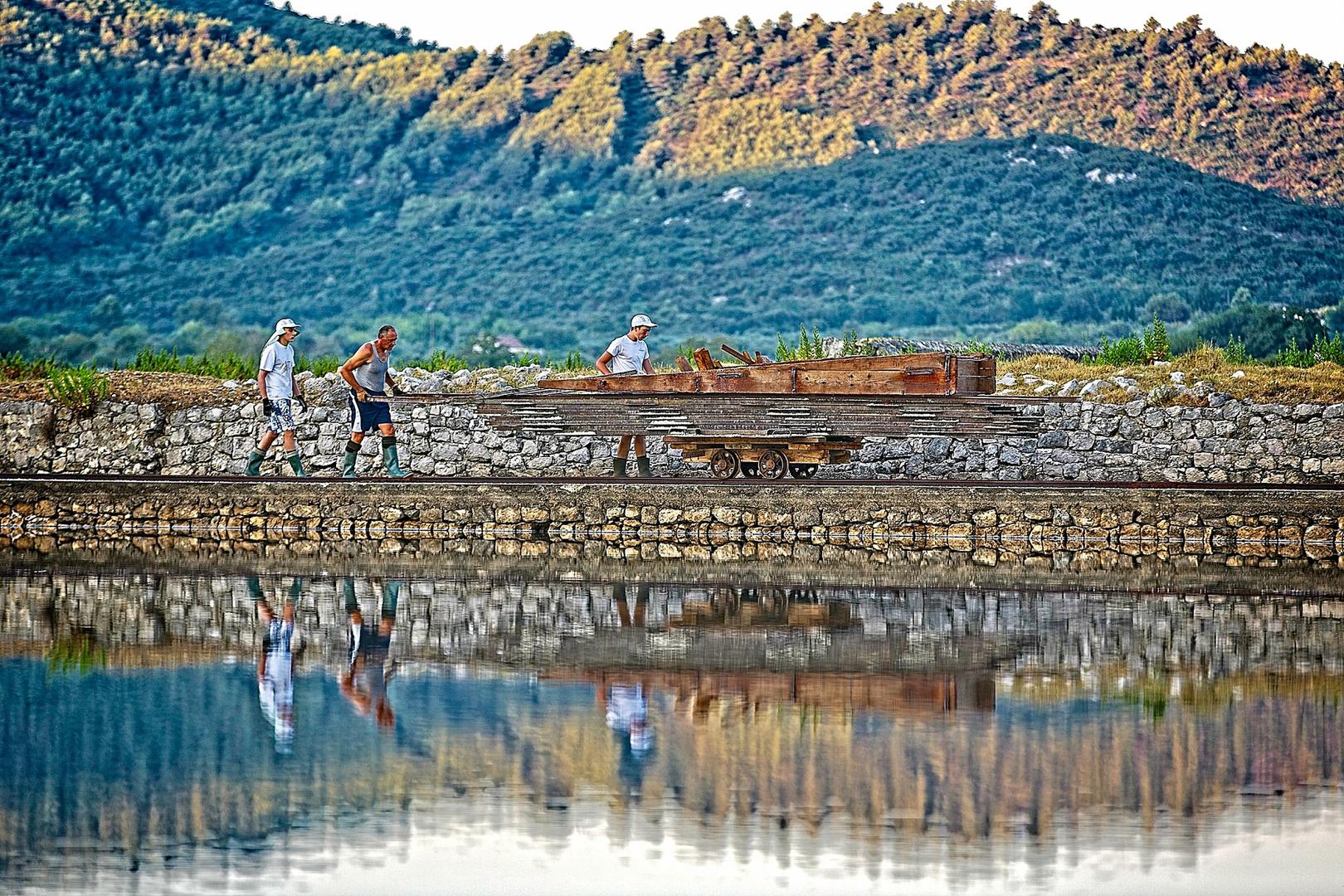
It's not too late to head to Pelješac, where the Salt Festival is ongoing until September the 20th. Visit the saltworks in Ston and discover how the production of salt, whose value was once so high that this town had to be surrounded by monumental walls, the longest after the Great Wall of China, has become one of the major attractions of the Dalmatian south.
Festival menus from Ston to Trpanj
The Salt Festival is the last of three summer festivals on Pelješac organized by all four tourist boards from the peninsula – Ston, Janjina, Orebić, and Trpanj. It's an opportunity to not only enjoy a glass of Plavac Mali but also savor the finest specialties, including the renowned Ston oysters. Pelješac's taverns, wineries, shellfish farmers, restaurants, and family-owned agricultural estates, numbering more than forty, have ensured that you can relish delicious local delicacies and beloved Plavac wines at favourable festival prices. Restaurant chefs have crafted two special menus, priced at 19,90 and 30,50 euros, while participating wineries offer their wines at up to 20% discounted prices.

The only salt in the world without additives.
Rich in mineral content, sea salt is of the highest quality, and Ston salt has been among the best for centuries... It is the only salt in the world without additives, produced in the same way as during ancient Rome, an essential seasoning and still the only preservative for delicacies like Dalmatian prosciutto. Ston Saltworks produces around 330 tons of salt annually; it's interesting that this is nearly half as much as the record-breaking 6,011 tons extracted in distant 1611. This was during the time of the Dubrovnik Republic when Ston salt held strategic importance and its kilogram was valued as highly as a kilogram of gold, hence encircled by monumental walls, the longest after the Great Wall of China, making it one of the greatest attractions of Dalmatian south today.

The pools still bear the names of saints.
For the sale of salt, the rector of the Dubrovnik Republic in Ston established a special office, strict records were maintained, and salt was issued only in the presence of two notaries and a scribe, who, along with the rector, were the sole possessors of the keys to its storage. During salt extraction, mobilization was in effect, and workers were paid in gold or salt; their duty was to bring donkeys and horses for carts. Names for the crystallization pools were carved into stone during the time of the Dubrovnik Republic. Even today, salt is extracted from pools named after saints: St. Blaise, St. Francis, St. Nicholas, St. Anthony, St. John, St. Peter and Paul, Mary and Joseph. Only one pool is not named after a saint. Its name is Mundo, translating to "world" or "people," and its salt was kept in a separate storage. From it, the prince received a small portion, a few bags went to the church, and everything else was distributed to the population that couldn't afford to buy salt.


 EN
EN  HR
HR